The Central African Republic: What Remains When the State Has Almost Vanished
The Central African Republic recorded honestly: what travel is possible, what is not, and what the country asks of anyone who still decides to go.
- Flag
-
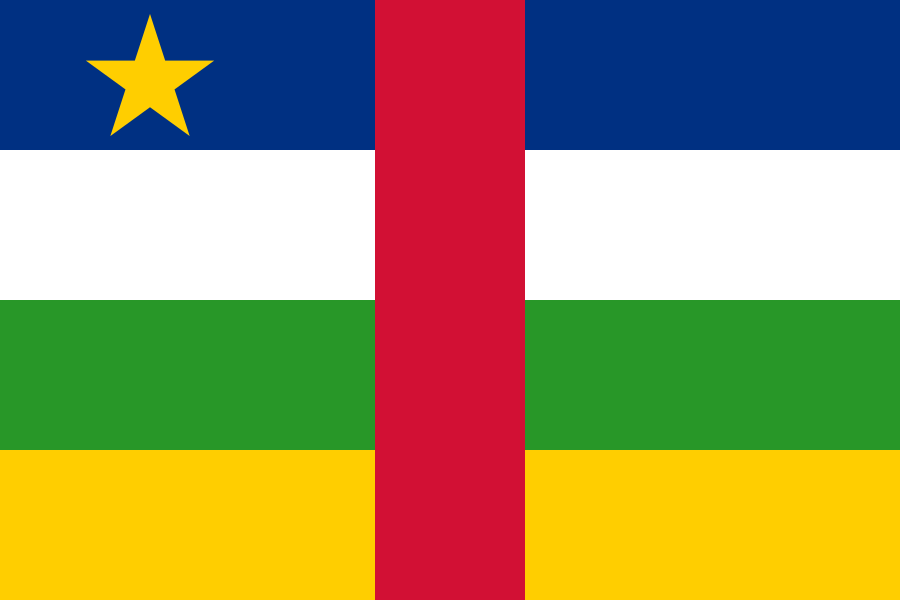
- ISO code
- CF
- Population
- 4,666,377
- Currency
- XAF
- Dial code
- +236
Bangui at Dusk
The Oubangui River catches the last light at 17:30, flat and brown, sliding past the capital toward the Congo. Women wash clothes in the shallows on the Bangui bank. Men haul sand from small boats. A few children kick a deflated football on what passes for a beach. The city behind them hums with generators and the occasional crack of a distant rifle. This is the Central African Republic. If you are considering going, you need the honest version first.
Nearly every foreign ministry advises against all travel to the CAR. Active armed groups control large parts of the territory. Violent crime is a daily reality in Bangui. Kidnapping risk is high. State authority has receded so far from most of the country that the term fails. The small number of travellers who still go—aid workers, NGO contractors, researchers, and the very occasional independent traveller with specific business—operate in a space where official warnings are the starting point, not an exaggeration.
The central question is not whether you should go. It is whether you can do what you need to do without getting yourself killed or needing an evacuation. For most people the answer is no. For the handful who still need to know what is possible, here is the ground truth.


- Security Summary: Most foreign ministries advise against all travel. Active armed groups, violent crime, kidnapping risk, and absence of functioning state authority across much of the country. This is a record, not an invitation.
- Capital: Bangui
- Languages: French, Sango
- Currency: Central African CFA franc (XAF)
- Population: 5.7 million (UN, 2024 estimate)
- Area: 622,984 km²
- Major River: Oubangui (Ubangi), forming much of the southern border
- Dzanga-Sangha Access: Fly-in only. Charter flights from Bangui or regional hubs. No reliable overland route.
- Dzanga-Sangha Notable Species: Forest elephant (Loxodonta cyclotis), western lowland gorilla (Gorilla gorilla gorilla)
- Dzanga-Sangha Accommodation: Sangha Lodge, Doli Lodge
- Malaria Risk: High, year-round, throughout the country
- Yellow Fever: Required for entry. International Certificate of Vaccination or Prophylaxis mandatory.
- Bangui Airport Code: BGF
- Time Zone: West Africa Time (WAT), UTC+1
- Driving Side: Right
- International Dialing Code: +236
- Overland Travel Feasibility: Not practically possible for foreign visitors. Roads insecure, checkpoints uncontrolled, borders frequently closed without notice.
What is Actually Possible Right Now
The map of accessible CAR is tiny. For a country the size of France, the usable travel corridor runs along two axes: the Oubangui River south of Bangui and the RN8 north toward Bozoum when conditions permit. That is it. Everything else is controlled by armed groups or is too insecure for reliable movement.
Bangui itself is the main event. The city has a raw riverine life that feels older than the state that nominally governs it. The M'Poko River market runs along the banks most mornings, selling smoked fish, dried caterpillars, and imported plastic goods from Cameroon. The Musée National Barthélemy Boganda is worth one hour for its ethnographic collection of masks, harps, and bark cloth, though the building has not seen maintenance funds in years. The cathedral of Notre Dame d'Afrique holds mass in Sango and French on Sunday mornings. Attend if your situation allows it. It is one of the few public gatherings in the capital that still feels communal rather than defensive.
Bozoum And The RN8
The road to Bozoum runs north from Bangui through Bossembélé and Bossangoa, a long stretch of laterite and potholed asphalt. When the road is open, and it often is not due to militia activity or rainy season washouts, the journey takes 8 to 12 hours in a 4x4 you must bring yourself. Bozoum is a small Catholic mission town where a handful of NGO staff rotate through. There is no tourism infrastructure. Do not go for sightseeing. Go if you have specific professional business with one of the humanitarian organisations operating there.
Bouar, further north near the Cameroon border, is effectively off limits for foreign visitors. The situation around the border crossings is unpredictable. Checkpoints are uncontrolled. Do not attempt it.
The Mbaïki Forest And Pygmy Communities
Southwest of Bangui on the RN6, the town of Mbaïki sits at the edge of dense tropical forest. The forest is home to Bayaka (often called Pygmy) communities whose knowledge of the forest environment is the main reason anyone goes this direction. Arrange visits through one of the small conservation NGOs based in Mbaïki. You need a local intermediary. Direct contact without one is culturally insensitive and potentially dangerous if you are mistaken for a poacher or a spy.
Pay for the visit. Pay fairly. The ethical question here is unavoidable: you are a foreigner with resources visiting a community that has been marginalised for generations. If you cannot answer for yourself why you are there beyond curiosity, skip it. The forest itself is spectacular: closed canopy, buttress roots, the calls of hornbills and monkeys. But the human encounter carries weight.
Dzanga-Sangha Special Reserve
Dzanga-Sangha is one of the great wildlife reserves of Central Africa and it is nearly impossible to reach. Fly-in only. Charter flights from Bangui or from regional hubs like Yaoundé in Cameroon. The reserve holds forest elephants (the smaller, round-eared species Loxodonta cyclotis) and western lowland gorillas (Gorilla gorilla gorilla). Sangha Lodge and Doli Lodge are the two accommodation options. Both require booking weeks in advance through a tour operator. The cost runs into the thousands of dollars for a short trip. If you have the budget and the logistics partner, this is the single best thing the CAR offers. If you do not, the reserve is effectively inaccessible.
The Logistical and Ethical Weight of the Place
The CAR forces you to confront questions that most travel does not. Every movement requires a calculation. Is the road open? Is the checkpoint manned by government soldiers or by armed group fighters? Do you have enough fuel to turn around? Do you have a satellite phone? Does your organisation know your route? What is the evacuation plan?
Medical evacuation is not hypothetical here. The WHO classifies malaria risk as high, year-round, throughout the country. Bangui has a handful of hospitals staffed by international NGOs, but serious injury or infection means evacuation to Nairobi or Johannesburg. Your insurance policy must cover helicopter and fixed-wing evacuation. Double check the exclusion clauses. Most standard policies exclude the CAR outright.
The ethical dimension is harder. The CAR is not a place to satisfy personal curiosity. The country has been in some form of crisis since the 2013 Séléka rebellion and the subsequent anti-balaka conflict. Much of the population is displaced. Food insecurity is chronic. When you hire a car and a driver in Bangui, you are paying a rate that is ten times what a local teacher earns. When you buy a carved statue at the market, you are participating in an economy where the line between artisan goods and looted cultural property is blurry. There are no good answers. The only honest advice is to be aware of what you are doing and to carry cash in euros or dollars. The ATMs in the CAR regularly reject foreign Visa cards and the banking system is unreliable.
If you are not attached to an organisation with a safety protocol, do not come. If you are, move quickly, keep a low profile, and exit when your business is finished. The CAR is not a place to linger. For a different kind of difficult travel, Mali offers the storied Niger River and ancient cities, though large areas remain beyond secure reach.
A Viable Day in Bangui
A viable day in Bangui starts at dawn. By 06:00 the heat is already building. Move by private vehicle with a driver who knows the city and has a working relationship with the checkpoints that appear without warning on the main boulevards. Visit the Ngaragba market early, before 09:00, when the shade still holds and the fish is fresh from the river. By midday the city slows. The power cuts start. Retreat to your accommodation to file reports and charge devices off a generator.
Evenings are spent on the terrace of a hotel like the Oubangui Hotel or the Résidence du Centre, where the international crowd gathers. These are not social spaces in the normal sense. They are bubble spaces where people compare updates and share information about which roads opened or closed that day. Do not go out after dark. Do not walk. Bangui after sunset belongs to people who are not tourists.
On The Road North And South
The road to Bozoum, when it is open, is a 12 hour commitment in a 4x4 with spare fuel, spare water, a satellite phone, and at least one armed guard if your organisation requires it. The checkpoints along the RN8 are the main variable. Some are formal military, some are informal armed groups, and the difference is not always obvious. Keep photocopies of your passport, visa, and any NGO accreditation visible. Speak French or Sango. Do not take photographs at checkpoints.
Mbaïki is a shorter drive, three to four hours south on the RN6. The road is paved until the last stretch. The forest begins abruptly. The Bayaka communities you visit live in camps off secondary tracks. Pay the village chief a negotiated fee for entry. Pay your guide separately. Do not give sweets or money directly to children.
Dzanga-Sangha is a different world entirely. The charter flight from Bangui takes about two hours. The lodges are comfortable, the guiding is professional, and the forest elephant encounters at the Dzanga Bai are among the most extraordinary wildlife experiences in Africa. But the price and the logistics mean this is not an add-on. It is the reason for the trip. Budget for a minimum of five days at the reserve itself.


The Honest Bottom Line
The Central African Republic is not romantic. It is not an adventure destination. It is a place where the state has receded to a handful of paved streets in Bangui, and the rest of the territory is contested by armed groups who do not care about your travel plans. The river still flows. The forest still stands. The people still carry their lives forward with a resilience that is humbling to witness. But that does not make it a place you should visit for a holiday.
If you must go for work, for research, or for family, move quickly, keep your head down, and get out when your business ends. The single most practical thing you can do right now: contact the safety office of whichever organisation or embassy you are affiliated with and ask for the current road status on the RN8 to Bozoum and the RN6 to Mbaïki. If you do not have an affiliated organisation, do not get on the plane.
Common Questions
Is it safe to travel to the Central African Republic right now?
No. Most foreign ministries advise against all travel. Active armed groups, violent crime, and kidnapping risk exist across much of the country, including Bangui. This is a record for the small number of travellers with specific professional reasons to go, not a recommendation.
Do I need a visa to enter the CAR?
Yes. A visa is required for all nationalities except a small number of African states. You must obtain it before travel at a CAR embassy or consulate. There is no reliable visa on arrival for most passport holders.
Can I visit Dzanga-Sangha without a tour operator?
No. Access is fly-in only via charter flights from Bangui or regional hubs. You need a tour operator to book the flights, the lodges, and the guiding. Overland routes to the reserve are not secure. Budget for several thousand dollars for a short trip.
What medical preparations are essential for the CAR?
Malaria risk is high year round. You need antimalarial medication, mosquito repellent, and a mosquito net. Yellow fever vaccination is mandatory for entry. Your travel insurance must cover helicopter and fixed-wing evacuation to Nairobi or Johannesburg. Most standard policies exclude the CAR.
What is the most common mistake travellers make in the CAR?
Underestimating the safety and logistics burden. This is not a place for independent travel or improvisation. You need a pre-arranged protocol, a reliable 4x4, spare fuel, a satellite phone, and cash in euros or dollars. ATMs regularly reject foreign cards. Do not come without an organisation backing your movements.
Read next
-
 Getting to Nauru, the Pacific State Where Air Schedules Define Your Stay
A logistics briefing on reaching Nauru by air — covering weekly flights from Brisbane and Honiara, visa-on-arrival requirements, and planning around fixed departure dates.
Getting to Nauru, the Pacific State Where Air Schedules Define Your Stay
A logistics briefing on reaching Nauru by air — covering weekly flights from Brisbane and Honiara, visa-on-arrival requirements, and planning around fixed departure dates.
-
 Nauru, the Pacific Republic That Phosphate Built and Nearly Erased
Nauru is one of the Pacific's most overlooked republics. A candid guide to topside, Buada Lagoon, colonial history, and how to actually get there.
Nauru, the Pacific Republic That Phosphate Built and Nearly Erased
Nauru is one of the Pacific's most overlooked republics. A candid guide to topside, Buada Lagoon, colonial history, and how to actually get there.
-
 Planning Independent Travel in the Wakhan Corridor, Tajikistan
Independent travel in Tajikistan's Wakhan Corridor: GBAO permits, road conditions from Ishkashim, realistic travel windows, and honest logistics for serious overlanders.
Planning Independent Travel in the Wakhan Corridor, Tajikistan
Independent travel in Tajikistan's Wakhan Corridor: GBAO permits, road conditions from Ishkashim, realistic travel windows, and honest logistics for serious overlanders.