Getting to Nauru, the Pacific State Where Air Schedules Define Your Stay
A logistics briefing on reaching Nauru by air — covering weekly flights from Brisbane and Honiara, visa-on-arrival requirements, and planning around fixed departure dates.

Nauru does not forgive improvisation. The island sits in the central Pacific, eight degrees south of the equator, covering 21 square kilometres of raised coral and mineral-stripped upland. It has one airport. One airline serves it on a schedule that shifts without formal public notice. Miss your departure window and the next available seat may be four, five, or seven days away. That reality shapes every decision you make, from choosing your travel window to confirming your return leg before you have even packed.
Flight Briefing
Nauru has two air connections, both operated by Nauru Airlines. Services run from Brisbane in Australia and Honiara in the Solomon Islands, typically once or twice a week on each route. Visa on arrival applies to most nationalities. There is no secondary carrier, no ferry link, and no alternative runway on the island. Every traveler arrives and departs on the same narrow band of scheduled flights. Build your entire itinerary around those windows before anything else.
One Airline, One Runway
Nauru Airlines is the only scheduled carrier serving Nauru International Airport, identified by the IATA code INU. The airline has operated under various names since the 1970s. Its network contracted considerably as phosphate revenues declined over the decades, and today it runs a tight Pacific circuit linking Nauru to Brisbane and Honiara. Occasionally the routing includes Nadi in Fiji or another island stop, but those connections are not reliable planning anchors. Treat Brisbane and Honiara as your fixed reference points and treat any additional stop as a variable that may or may not exist when you actually book.
The runway at INU is paved and capable of handling jet-equipped aircraft, but Nauru Airlines typically deploys turboprop equipment on its Pacific legs. Turboprops carry far fewer passengers than regional jets. A single mechanical delay does not just postpone one flight. It can remove a substantial share of the week's total available seats in one event, leaving a queue of affected travelers with no alternative service until the next scheduled departure.
Flying in from Brisbane or Honiara
Brisbane is the primary international gateway. The flight crosses roughly 4,000 kilometres of open ocean and runs approximately four hours. Connections from Brisbane tend to be marginally more consistent in scheduling than those from Honiara, and Australia offers a far greater range of rebooking options if your dates need to shift. Brisbane Airport also has a dense international network, which matters when you are coordinating Nauru with a longer itinerary.
Honiara on Guadalcanal offers a more unusual approach and fits naturally into a Melanesian arc. If you are already moving through the Solomon Islands, folding Nauru into the route makes geographic sense. The Solomons' own international connections are limited, running mainly through Fiji and Brisbane, so sequencing the full route requires close attention to each leg independently. Do not assume standard hub convenience applies.
Whichever gateway you use, verify the current timetable directly with Nauru Airlines before any other planning step. Schedules displayed on third-party booking engines can lag behind actual operational changes by days or weeks. The airline's own reservations team is the only source of real-time availability you can act on.
Visa on Arrival and What to Have Ready
Most nationalities receive a visa granted at the airport on arrival, valid for 30 days. Because Nauru maintains no embassy presence in most countries, any last-minute entry issue is nearly impossible to resolve from abroad before your flight departs. Australian government travel advice for Nauru specifically flags that entry requirements can change at short notice, and recommends verifying current requirements well ahead of departure rather than relying on information from a previous visit or a third-party source.
Before you board, confirm the following are in order:
- A return or onward ticket confirmed on a specific date, not left open-ended
- Written proof of accommodation for every night of your stay, however informal the guesthouse
- Evidence of sufficient funds for daily costs plus a meaningful buffer in case of an extended stay
- A valid passport with at least six months of remaining validity beyond your intended departure date
- Any re-entry vaccinations your home country requires after travel to this part of the Pacific
The visa fee is modest and payable at the immigration desk on arrival. Carry Australian dollars in cash. Card acceptance at immigration is not guaranteed, and there is no fallback option if you arrive short of the fee.
When Your Flight Vanishes from the Tracking Screen
If you are watching your Nauru Airlines service on a flight tracker in the hours before check-in, prepare for something that looks alarming but almost certainly is not. Over the open Pacific, civilian ADS-B receivers and ground-based radar provide no meaningful coverage. An aircraft can be airborne, on time, and entirely invisible to any tracking platform at the same time. Reading about why flights disappear from tracking displays is worth doing before your trip, because the difference between a genuine cancellation and ordinary ocean invisibility becomes an urgent question in a place where the next confirmed seat may be a full week away.
This is not a marginal concern. A genuine cancellation does not disrupt your day. It disrupts your week. Treating a blank tracking screen as confirmation of a cancellation and triggering a chain of rebooking calls, when the aircraft is in the air and on schedule, would be a costly error. If you lose the signal and need current operational information, contact Nauru Airlines ground staff directly in Brisbane or Honiara. They have live data that no civilian tracker can provide over open ocean.
The Island You Actually Land on
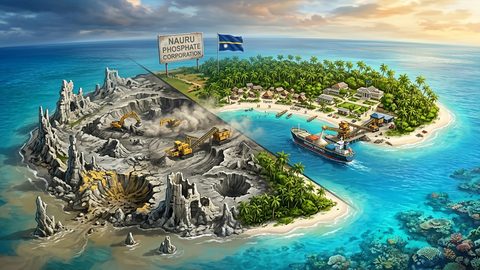
The first thing to correct is the mental image. Nauru does not resemble the photographs that represent most of the Pacific in travel culture. There is no forested mountain interior, no river valley, and no dramatic ridge line draped in cloud. Phosphate mining stripped the island's interior down to bare coral limestone pinnacles over most of the twentieth century. What remains is a landscape called "topside," a terrain of jagged white coral spires, sparse scrub regrowth, and rusting industrial infrastructure scattered across a plateau that looks more like an abandoned quarry than a tropical island. It is worth seeing. But it requires preparation for a landscape that does not match its geographic category.
The coast operates at a different register. A perimeter road circles the entire island for approximately 19 kilometres, passing fishing settlements, the parliament building, modest local stores, and stretches of reef-edged beach that receive almost no visitors. The road is the journey. There is no interior loop, no secondary circuit, and no risk of becoming directionally lost. You can walk the full perimeter in a long day or drive it in under an hour.
Guesthouses, Meals, and the Limits of the Accommodation Market
Nauru's accommodation is a handful of guesthouses and two main properties. The Menen Hotel is the largest, carrying the majority of visiting business travelers, government contractors, and aid workers who form the dominant share of overnight stays. The Od-N-Aiwo Hotel is a smaller alternative with a more local character. Beyond those two, a small number of family-run guesthouses take bookings by arrangement, most without any presence on international booking platforms.
Rooms must be confirmed before departure. The visitor base is heavily weighted toward contract workers on extended stays, meaning availability can tighten quickly around project start dates or regional meetings, regardless of how small the island appears on a map. Arriving without confirmed accommodation is a serious miscalculation. There are no hostels, no camping grounds, and no informal overnight alternatives.
Meals come from the hotel restaurants and a small number of local eateries. The menus are narrow, built largely on imported goods. Fresh fish appears when conditions have been favorable. Do not arrive with expectations shaped by the broader Pacific food culture. Practicality is the operating mode throughout.
Building a Trip around the Departure You Can Actually Book
Most visits to Nauru run between five days and two weeks. The island's compact geography means you can walk the perimeter road, visit the Buada Lagoon in the interior basin, and cover every accessible point of interest comfortably within a few days. But the length of your stay is not entirely a personal decision. It is determined by which departure seats exist in the published schedule at the time you book.
The reliable approach is to select your outbound departure date first, before confirming accommodation, before booking onward flights from Brisbane or Honiara, and before any other element of the itinerary. If the departure you want does not exist in the schedule, your trip length adjusts. If a seat on a short-turnaround service is not available, you plan for a longer stay or reconsider your travel dates entirely.
Build at least one full day of buffer between your departure from INU and any time-sensitive international connection from your gateway city. A minor operational delay at Nauru, absorbed without consequence under normal circumstances, can cascade into a missed intercontinental flight if the margin is too tight.
When the Schedule Becomes Your Itinerary
Nauru asks something that most destinations do not. It requires you to build your plans around a timetable you cannot fully control, in a place with no meaningful backup when that timetable changes. The travelers who get the most from the island are the ones who accept that condition before they book, not after they land and discover the return flight they assumed would be easy to adjust is the only seat available for six days.
The phosphate-stripped topside, the quiet perimeter road at low traffic hours, the guesthouses where fellow guests are mostly engineers and health workers on contract, the reef at low tide with no other visitors. These are real things, accessible and unhurried. Getting to Nauru is genuinely achievable for any independent traveler willing to work within the system. Confirm your return ticket before you arrive. Everything else follows from that.
Read next
-
 Nauru, the Pacific Republic That Phosphate Built and Nearly Erased
Nauru is one of the Pacific's most overlooked republics. A candid guide to topside, Buada Lagoon, colonial history, and how to actually get there.
Nauru, the Pacific Republic That Phosphate Built and Nearly Erased
Nauru is one of the Pacific's most overlooked republics. A candid guide to topside, Buada Lagoon, colonial history, and how to actually get there.
-
 Planning Independent Travel in the Wakhan Corridor, Tajikistan
Independent travel in Tajikistan's Wakhan Corridor: GBAO permits, road conditions from Ishkashim, realistic travel windows, and honest logistics for serious overlanders.
Planning Independent Travel in the Wakhan Corridor, Tajikistan
Independent travel in Tajikistan's Wakhan Corridor: GBAO permits, road conditions from Ishkashim, realistic travel windows, and honest logistics for serious overlanders.