Caracas and the Central Cities: A Record of Venezuela's Historic Plazas
A record of Venezuela's central cities—Caracas, Maracay, Valencia and Colonia Tovar—where dignified plazas anchor a complex urban heritage.
- Flag
-
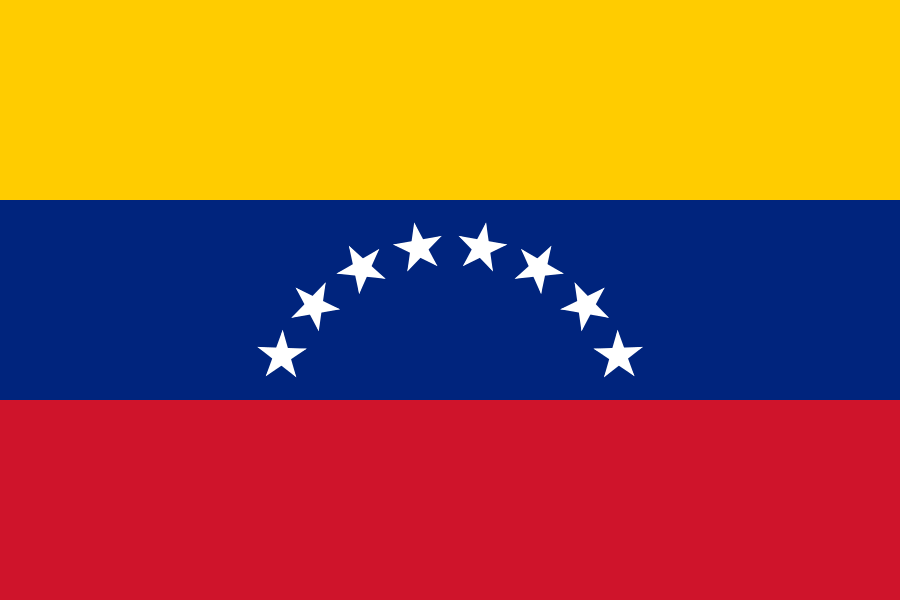
- ISO code
- VE
- Population
- 28,870,195
- Currency
- VES
- Dial code
- +58
Caracas and the Central Cities: a Record of Venezuela’s Historic Plazas
Picture what Venezuela's central corridor looked like before the headlines swallowed it. A specific order: the slow morning bustle of a plaza Bolívar, the arcaded shade of the garrison city, the odd Alpine interruption of Colonia Tovar in the clouds. The cities of the centre, fixed in the years before shortages and crisis erased the reliable rhythms, survive as an archival snapshot. No statistics. No crime tallies. Only the physical fact of the plazas and what they once held.
- Target Cities: Caracas (capital), Maracay (Aragua state capital, military garrison city, entry point for Henri Pittier National Park), Valencia (third-largest city, industrial centre, location of Arturo Michelena International Airport VLN)
- Core Urban Spine: The Caracas-Valencia-Maracay corridor runs west from the capital through the Aragua valley, connected by the Autopista Regional del Centro
- Key Architectural Pattern: Every town and city has a Plaza Bolívar, flanked by a church and government buildings, named after Simón Bolívar
- Notable Anomaly: Colonia Tovar, a Bavarian-founded settlement founded in 1843, sits in the hills above Maracay, 2,100 m elevation
- Dry Season: December to April. The rainy season (May to November) brings heaviest rain June through October, causing flooding and landslides
- Available Airports: Simón Bolívar International (CCS, Maiquetía, serves Caracas); Arturo Michelena International (VLN, Valencia)
Caracas: the Plaza That Anchors the City
The Square at First Light
Every Venezuelan plaza Bolívar is a fixed point. The one in the capital is the centre of the centre. Enter from Avenida Universidad, crossing from Metro station Capitolio, and the city's noise recedes behind a wall of trees and stone. The square is a perfect grid of paved paths dividing lawn. At its centre, the equestrian statue of the Liberator, his arm raised, faces the Capitol building to the south. To the west, the Cathedral of Caracas, built in the 17th century, presents a whitewashed facade. To the east, the Municipal Council building, painted pale yellow, its arcades shading cafe tables.
Arrive before 09:00. The heat builds fast, and the plaza is most itself in the hour when office workers cross it on foot, carrying paper cups of coffee from the kiosk on the north corner. The benches fill with older men reading newspapers. The fountain at the southeast corner runs, and children trail their hands in it. This is the plaza in its intended state: a civic room.
Los Caobos and the Museum Route
One block north, Los Caobos park offers a different calm. Its mature mahogany trees shade the National Art Gallery and the Museum of Fine Arts. The park connects to Bellas Artes Metro station. Walk the path from the plaza to the park, 10 minutes at an easy pace. Do not expect the park to be empty. On Sunday mornings, tai chi groups gather near the fountain, and the museum opens at 10:00 with a small entry fee in bolívars (cash only).

Maracay: Arcades and Military Order
The Garrison Plaza
Forty-five minutes west of the capital by highway, the Aragua state seat opens into a broader, flatter valley. Its Plaza Bolívar mirrors the capital's in layout, but the mood is different. This is a garrison city, home of the Venezuelan air force, and the square reflects a clipped discipline. The grass is uniformly short. The benches are painted the same institutional green. The church, the Catedral de Maracay, is a 20th-century structure with a single bell tower, modest compared to the capital's, but the arcades surrounding the plaza are the real draw.
Those arcades, continuous covered walkways with round arches, wrap three sides of the square. They house a row of shops selling hardware, stationery, and excellent pastries from a bakery on the northeast corner. Take a table inside the arcade. Order a coffee and a cheese-filled arepa. Watch the city's real activity: military officers in uniform walking in pairs, students from the university crossing to the bus stop, women selling fresh fruit juice from pushcarts. The plaza fills by midday, but the arcades stay cool in the shadows.
Henri Pittier: The Cloud Forest Ascent
This city is also your exit point for Henri Pittier National Park, the oldest national park in Venezuela. The park entrance is 20 minutes north by car. The road climbs from the valley floor into cloud forest. Within 30 minutes the temperature drops 10 degrees. Do not attempt the drive without a full tank of fuel; shortages are chronic and the nearest gas station may be dry. While Venezuela’s colonial plazas reward unhurried afternoons, Brazil tempts with a different rhythm in cities like São Luís, Fortaleza, and Belo Horizonte.
Valencia: Industry and a Plaza of Its Own
The Industrial Capital's Colonial Heart
Valencia, another 40 minutes west of the garrison city, operates at a different scale. Venezuela's third-largest city and its industrial core has a utilitarian feel. The Plaza Bolívar here sits in the older colonial centre, a tight grid of one-way streets and buildings painted in faded ochre and blue. The square is smaller than the capital's, more intimate, and the trees are taller, creating a full canopy. The church on the west side, the Catedral de Valencia, dates from the 18th century and holds a plain white interior with a gilded altarpiece.
The Mercado Municipal
The essential move here is to leave the plaza and walk south two blocks to the Mercado Municipal. The market occupies a block-long building with a red-tiled roof. Inside, the aisles are narrow and the light comes from bare bulbs. Vendors sell fresh produce, dried beans, and the regional cheese called queso de mano. The market works best as a morning stop, before the heat and the crowds peak at 11:00. Buy a paper cone of roasted peanuts from the woman at the entrance. Walk back to the plaza and eat them under the trees.
Flying Out of VLN
If you are flying out of this city, Arturo Michelena International Airport (VLN) is 10 minutes south of the centre. The airport is small, with a single terminal. Flights are cancelled with little notice. Confirm your flight the afternoon before departure. Arrive three hours early. The cafe inside the terminal serves coffee and sandwiches, but power outages may close it without warning.
| City | Travel Time from Caracas by Car | Plaza Character | Key Landmark on Plaza | One Thing to Do Nearby |
|---|---|---|---|---|
| Caracas | Base | Formal civic square, busy from 08:00 to 10:00 | Cathedral of Caracas (west side) | Walk to Los Caobos park and the National Art Gallery |
| Maracay | 45 min west | Military precision, arcaded shopping | Catedral de Maracay (single bell tower) | Eat an arepa under the arcades, then drive to Henri Pittier National Park |
| Valencia | 1 hr 25 min west | Compact, shaded by old trees | Catedral de Valencia (18th-century plain interior) | Buy roasted peanuts at the Mercado Municipal two blocks south |

.jpg)

Colonia Tovar: the Bavarian Anomaly in the Clouds
The Road Up
An hour's drive from the garrison city into the Cordillera de la Costa, the road climbs a series of switchbacks and the landscape abruptly changes. Pine trees replace tropical foliage. The temperature drops. Then you arrive at Colonia Tovar, a village that looks as if it were lifted from the Black Forest and set down in the Venezuelan mountains. Founded in 1843 by German immigrants from Baden-Württemberg, the town retains half-timbered houses with steep pitched roofs, flower boxes under every window, and bakeries selling pretzels and black forest cake. It is disorienting. It is genuine.
Plaza Centenario and the Church
The main square is not called Plaza Bolívar. It is the Plaza Centenario, a small cobbled space with a fountain at its centre and a church, the Iglesia de San Martín de Tours, on its east side. The church is painted white with a red roof. Its interior is sparse: wooden pews and a stained-glass window showing the village's patron saint. The square fills with tourists from the capital on weekends. On a weekday morning it is empty save for a few elderly residents sitting on the benches. Arrive on a Tuesday or Wednesday. Skip the weekend entirely, especially during the dry season from December to April, when traffic from the capital turns a 90-minute drive into three hours.
The Bakeries and the Fog
The bakeries are the real draw. La Posada del Alemán, on the main street two blocks north of the plaza, sells apple strudel and a dense rye bread. Buy a loaf for the drive back. The town's elevation, 2,100 metres, means afternoon fog rolls in by 15:00. Plan your visit to leave by 14:00, before the clouds reduce visibility on the descent.
Common Questions
Can I visit all three plazas in one day?
Technically yes, but do not try it. The drive from the capital to Valencia via the Aragua state seat takes roughly 1.5 hours in good traffic, but fuel shortages and highway police checks routinely double that time. Budget one morning for the capital, one for the garrison city (including a trip up to Colonia Tovar), and a third for the industrial hub. Three days for the corridor is the minimum.
Is Colonia Tovar worth the detour from Maracay?
Yes, but only on a weekday. The drive from the garrison city to Colonia Tovar is 60 minutes each way on a narrow winding road. On weekends the road is clogged with day-trippers from the capital, and the town's main street becomes a slow-moving queue of cars. Arrive by 08:00, buy your pastry, and be gone by 13:00.
Which plaza is most photogenic?
The capital's Plaza Bolívar in the early morning light, before 09:00, when the sun hits the yellow municipal building and the fountain is running. The Colonia Tovar plaza is more unusual but smaller, and its charm depends on empty benches and low fog, which you can only count on before 10:00 on a weekday.
What do I do if the fountain in Caracas Plaza Bolívar is dry?
It will be. The fountain is frequently without water due to shortages. It does not diminish the plaza. Sit on a bench facing the cathedral and watch the office workers cross. The plaza's value is in its function as a pedestrian centre, not its ornament. The dry fountain is, in its way, an honest record of the period.
Can I walk from the Caracas metro to the plaza safely?
Yes, during daylight hours. Take the Metro to Capitolio station. Exit onto Avenida Universidad and walk south 200 metres. The plaza is visible from the station entrance. Do not walk after dark. After 18:00, the plaza empties and the streets around it become unsafe. Take a taxi directly from the station to your accommodation if you are out past that time.
Read next
-
 Getting to Nauru, the Pacific State Where Air Schedules Define Your Stay
A logistics briefing on reaching Nauru by air — covering weekly flights from Brisbane and Honiara, visa-on-arrival requirements, and planning around fixed departure dates.
Getting to Nauru, the Pacific State Where Air Schedules Define Your Stay
A logistics briefing on reaching Nauru by air — covering weekly flights from Brisbane and Honiara, visa-on-arrival requirements, and planning around fixed departure dates.
-
 Nauru, the Pacific Republic That Phosphate Built and Nearly Erased
Nauru is one of the Pacific's most overlooked republics. A candid guide to topside, Buada Lagoon, colonial history, and how to actually get there.
Nauru, the Pacific Republic That Phosphate Built and Nearly Erased
Nauru is one of the Pacific's most overlooked republics. A candid guide to topside, Buada Lagoon, colonial history, and how to actually get there.
-
 Planning Independent Travel in the Wakhan Corridor, Tajikistan
Independent travel in Tajikistan's Wakhan Corridor: GBAO permits, road conditions from Ishkashim, realistic travel windows, and honest logistics for serious overlanders.
Planning Independent Travel in the Wakhan Corridor, Tajikistan
Independent travel in Tajikistan's Wakhan Corridor: GBAO permits, road conditions from Ishkashim, realistic travel windows, and honest logistics for serious overlanders.